Micro Water Management Toolkit for Sustainable Water Resource Areas in Climate Vulnerable Coastal Regions
In the climate-exposed Sundarbans of West Bengal, India, access to safe groundwater is becoming increasingly uncertain. Rising demand, salinisation and climate change place growing pressure on communities and authorities alike. This project has developed and tested a new micro-water management toolkit that provides real-time insight into groundwater levels across Basanti Block. This proof-of-concept supports a long-term resilience, better water security and more informed decision-making in one of India’s most climate-vulnerable regions.
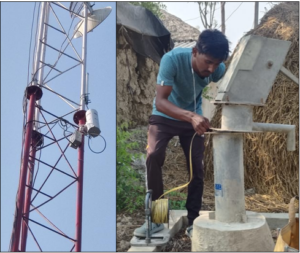
The purpose of the project was to explore a practical, reliable and cost-effective way for local authorities and citizens to understand—and ultimately manage—the area’s groundwater resources. The solution combines two approaches: a set of IoT sensors that transmit hourly measurements through a dedicated LoRaWAN network, and an “Internet of People” (IoP) system where trained local field workers collect weekly readings from 38 strategically selected wells. Together, these data streams feed into an online portal from the commercial partner, DRYP, that displays groundwater levels openly and transparently for the entire block. The project shows that even in remote and technologically challenging areas, reliable groundwater monitoring can be achieved—and at a cost level accessible for local governments.
Following thorough testing and further development, the project resulted in a validated business case for scaling the system to cover a much larger region. The project has also strengthened local capacity by engaging youth and women as field workers and by building new technical competencies in groundwater management.